Why the stone changes the cut
A faceting design is a set of angles, and the right angles depend on the material. The lower a stone's refractive index, the larger its critical angle and the steeper its pavilion has to be to keep light inside. A pavilion that is perfect in diamond can leave an amethyst looking washed out in the centre. Each page below gives the numbers for one stone and ranks all 31 cuts by how well they hold light in it.
- Diamond RI 2.417Critical angle 24.4°Guide pavilion 38.1°
- Moissanite RI 2.648 to 2.691Critical angle 22.2°Guide pavilion 37.4°
- Cubic Zirconia RI 2.15 to 2.18Critical angle 27.7°Guide pavilion 39.2°
- Ruby RI 1.762 to 1.770Critical angle 34.6°Guide pavilion 41.5°
- Sapphire RI 1.762 to 1.770Critical angle 34.6°Guide pavilion 41.5°
- Emerald RI 1.577 to 1.583Critical angle 39.4°Guide pavilion 43.1°
- Amethyst RI 1.544 to 1.553Critical angle 40.4°Guide pavilion 43.5°
One cut does not fit every stone
The clearest way to see it is two rounds that look almost the same on paper. The T73 carries the round brilliant proportions published in 1919, worked out for diamond. BL-Anteros keeps the same 73 facets and the same 53% table, but its crown and pavilion angles are re-solved for moissanite, which bends light more strongly. Put each in each stone and look.
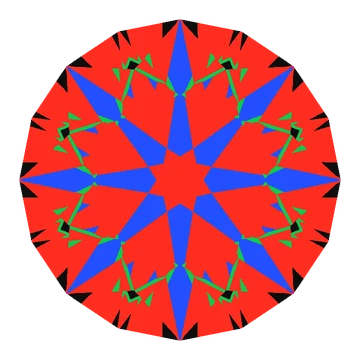
 Arrows, face-up
 Hearts, face-down

 Arrows, face-up
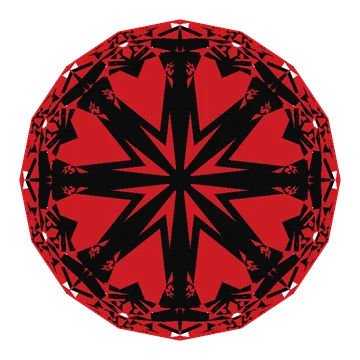 Hearts, face-down

 Arrows, face-up
 Hearts, face-down

 Arrows, face-up
 Hearts, face-down
Direct Indirect Contrast Leak. Face-up, the way a light-return scope shows a stone.
White: light from the viewer's white disk, which draws the arrows and hearts. Red: light from the red reflector. Black: the lens port, or light that never comes back.
All eight panels per instrument are computed from the cut files themselves, with the same rules for every stone. The Hearts & Arrows viewer has a 2.5° lens hole, a white disk to 13.5° and a red reflector to 90°.